
Microgrid Design, Sizing & Optimization
There is a growing worldwide trend for microgrids due to two main drivers: the provision of power to remote communities and industrial facilities; and the need for buildings or facilities that are normally grid-connected to be able to disconnect and function independently.
Microgrid Sizing and optimization in all sectors, from village power and island utilities to grid-connected utilities.
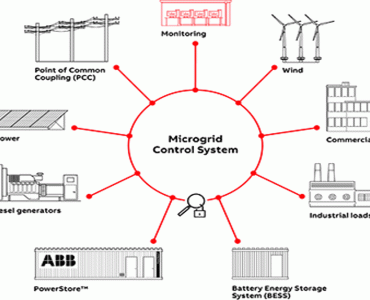
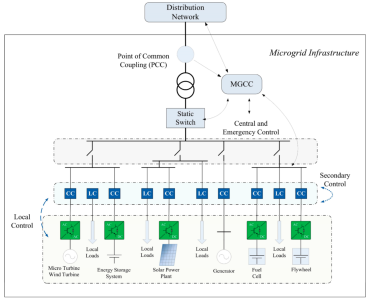
Microgrid Control System
Conventionally, operators have relied on diesel generators but they are now turning to renewables and especially solar photovoltaic (PV) installations to reduce their reliance on diesel fuel.
Creating schemes in which diesel generation and PV plant complement each other can offer considerable savings in terms of the costs of fuel purchase, transport and handling as well as maintenance, since diesel gensets are required to operate for fewer hours. There are also environmental benefits from reduced greenhouse gas emissions.
Integrating renewable energy resources into microgrids
Adding renewables to microgrids in the form of solar and wind power is an increasingly attractive option. The cost of solar and wind per kilowatt-hour is significantly lower than diesel. But because of the intermittency of renewables, diesel gensets are still needed to ensure the stability of the grid.
Using standard power electronics, PV can contribute up to 25 percent of the power that would be generated by the diesel genset at any time. Adding dedicated software can increase the penetration of PV to around 50 percent.
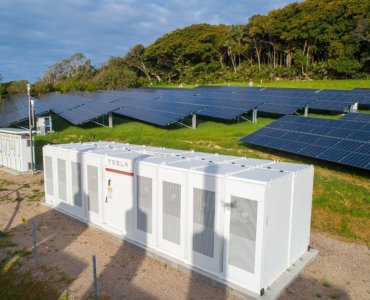
When an energy storage system (ESS) is added, an operator can maximize the contribution of renewables, increasing the penetration of PV power and allowing diesel-off operation. It is possible to realize fuel savings of 50 to 75 percent. Li-ion battery systems have emerged as the technology of choice for energy storage. This is due to their high energy density that enables significant levels of storage capacity to be packed into a relatively compact footprint. Li-ion ESSs are now able to store energy at the megawatt scale, and integrated containerized systems can be connected in parallel to deliver multiple megawatt-hour storage capacity.
The three main drivers for microgrid energy storage
The first driver is that increasing the usage of PV reduces the running hours of the genset. Without energy storage, excess PV would be lost (or curtailed) but an ESS can store excess PV for use later. In addition, the power output of the PV panels is smoothed so that the genset will need to start and stop less often to compensate for the variation in PV.
Second, the diesel genset will be able to run at its point of maximum efficiency, rather than ramping up and down to meet changing demand. This reduces operational and maintenance costs as well as eliminating the need to provide spinning reserves.
Lastly, integrating energy storage enables an operator to operate their genset only when needed to support loads or to charge the battery.

We do :
- Feasibility study
- Modelling and design
- Simulation & optimization
- Installation and commissioning
- Maintenance